You should have some sense of how busy I've been that I'm only now, in the middle of June, getting around to wrapping up my thoughts about 2011. I don't know quite what accounts for the tardiness of this post. I've been working consistently, certainly, but I've taught this number of classes before. It just seems that I don't have as much available time to collect my thoughts and write. I'd also suspect that being in a relationship has a direct impact on one's free time, but he and I are hardly jetsetters. In fact, we spend most of our time at home either studying for exams (him) or grading papers or reading for lesson preparation (me).
Ah, well, let's put the past behind us so that we can move on.
Last year I read 44 books, not a bad number overall. Included in that number were several books of poetry, but I'm not listing any of them as a favorite this year because most contemporary poetry seems so...distant. I enjoy reading a poem or two in a collection of new work, but the rest will leave me quite unimpressed. I managed to see 26 full-length movies last year and four collections of short films on the big screen (26 short films in all). I would love to go to the movies more often, but sometimes you can't get everyone on board to get out of the apartment to see a film. That is even more true for going to see a live show, given that I went to the theatre only three times this past year and all of the shows were at my college. Sigh. Perhaps this year will be better.
Favorite Fiction Book: Dean Bakopoulos' Don't Come Back from the Moon has been sitting on my bookshelves since Bakopoulos was our college's Visiting Writer several years ago. I purchased the book then and put it aside, promising to read it someday. I finally got a chance this past year, and I wish I had started it sooner. It's a novel about a town where all of the men begin to disappear, leaving teenage boys to become the "men" of the community. It's by turns amusing and enlightening. I particularly admired Bakopoulos' ability to capture the voice of boys on the cusp of manhood and all of the concerns that they have about what it means to be a man. The novel deals with the responsibilities of work these boys must assume and their first fumbling attempts at becoming sexually active men. The title, by the way, refers to the assumption made by the remaining townspeople that the men have all gone to the moon. Don't assume, however, that this is just a science fiction or fantasy tale; it's really an evocative picture of a small town and of the moment in life when one becomes an adult.
Runner-Up: Years ago, thanks to a friend of my mother's, I received dozens of Agatha Christie novels. I have read and reread them over the years and decided to pick up three more this past year to enjoy: Dead Man's Mirror, The Labors of Hercules, and There Is a Tide. What I have always enjoyed about Christie's writing is the depiction of her major characters, whether Hercule Poiroit (my personal favorite), Miss Marple, or Tommy and Tuppence. I will admit that I do not always figure out "whodunit" before the end of the novel when I read a Christie book, but I always enjoy the journey.
Favorite Nonfiction Book: Norah Vincent's Self-Made Man was a book that I assigned my Honors Critical Reasoning and Writing class. I had read the synopsis of Vincent's book online and thought it would make for an interesting discussion point about definitions of gender and gender roles. I was fascinated by how Vincent was able to disguise herself as a man and be accepted by other men without question (well, for the most part, anyway). She manages to make some very trenchant points about what it means to be a man (and, by extrapolation, what it means to be a woman) in this book. It's a fine piece of investigative journalism, and the papers the students wrote as a result of reading this book covered some very intriguing topics as well.
Runners-Up: I have been a fan of both Pat Benatar and Rick Springfield since their heydays in the 1980s. This past year, I saw both of them in concert, the first time that had happened since the 1980s, and I read their respective autobiographies. Both of them are very direct and often blunt about the issues that they faced to become successes. Benatar's Between a Heart and a Rock Place give you a clear sense of just how sexist the music industry is and just how level-headed (most of the time) Benatar was. It's also a great love story about her relationship with her husband, Spyder. They've managed to last through some pretty difficult times in life, but you get a very real sense of just how much they have come to depend upon each other. Springfield's Late, Late at Night, similarly, discusses his romantic entanglements, including a liaison with Linda Blair that I didn't remember. However, what I found most intriguing about this autobiography was his honesty about his battles with depression. The directness with which he describes himself as being at times suicidal is particularly shocking. I would have found both of these books interesting just for the background they give of two of my favorite performers, but to learn what they have endured has given me a deeper appreciation of their talents.
Favorite Film: Source Code was such a good movie, and I don't think it got the attention that it deserved. The plot involves a soldier (played by Jake Gyllenhaal) who has to keep returning over and over to the same commuter train in order to stop it from blowing up. He's only given a few minutes each time to discover who is carrying the bomb before he returns to some sort of vehicle. He only has contact with a woman identified as Goodwin (Vera Farmiga), but she won't give him information on where he is or what has happened to him. Did I mention that he's also in someone else's body when he "wakes up" on the train? And that he starts to fall in love with one of the other passengers (played by Michelle Monaghan)? It's this combination of science fiction and thriller and romance and mystery that kept me intrigued throughout this film. I don't know if other audience members found it too confusing, but I was surprised when it received little to no attention at the end of the year. It's a great movie worth finding on DVD.
Runner-Up: Hugo was a magical movie, a treat for fans of silent film, in particular. Direct Martin Scorcese managed to capture the excitement and wonder of childhood discovery and pay homage to one of the founders of cinema in the process. I didn't see the film in 3D because I've tried to avoid paying extra for the privilege of wearing a pair of glasses over my own pair of glasses, but even in plain old 2D, I appreciated the remarkable world of that Paris train station where much of the movie takes place.
Favorite Documentary: Making the Boys details the history behind one of my all-time favorite movies, The Boys in the Band, a significant movie in gay history. Including interviews with the playwright, Mart Crowley, and many of the surviving cast members, the documentary details how the 1970 film was created from the play and the reception that it received and its place in cinematic history. I dragged The Boyfriend to the Laemmle Sunset 5 (not long before it closed, actually) to see this documentary, and even he found it rather interesting even though he had never seen The Boys in the Band. My first published work in a journal was an article on The Boys in the Band, so I was intrigued by all of the details that the filmmakers managed to include about the background of Crowley and other key participants.
Runner-Up: I had hopes that We Were Here might win this year's Academy Award for Best Documentary Feature, but even though it was shortlisted, it didn't make the final set of nominees. That's a shame because this film manages to evoke a very clear sense of time and place. It's a history of the early years of the AIDS crisis in the city of San Francisco, and it features interviews with some remarkable people who survived that era. Many of the stories captured in this film might have otherwise been lost, and We Were Here can serve as a good introduction to people who don't know (or cannot recall) what happened in those scary times of the early 1980s.
Favorite Female Performance: Kirsten Wiig in Bridesmaids manages to mix slapstick comedy and broad, physical humor with touching, quiet moments of sadness and loneliness. It's a hell of a great performance, but comedic performances do not tend to get much appreciation. Wiig throws herself into the role of friend of the bride and never looks back. She allows you to see the envy she feels that her friend is getting married and the sadness she experiences when she realizes that they are no longer as close as they once were. She displays deep jealousy when a rival for the bride's attention seems to be winning, and she is absolutely charming when she meets a police office who might be a romantic interest for her. Much of the attention for Bridesmaids was on the so-called gross-out humor, but in truth, that's only a couple of scenes. The rest of the film is about the nature of friendship and the complications of love and the fragility of relationships. And Wiig is at the center of all of those themes.
Runner-Up: I have yet to see Meryl Streep's performance in The Iron Lady, so I don't know how it would stack up to Viola Davis in The Help. However, of the nominees for Best Actress that I did see, Davis was far above the rest. No one is in her league when it comes to showing just how crushing and silencing years of racism can be on the soul of a person. When she has a rare moment of humor, her smile is so luminous, revealing just how important such moments are to the sanity of people who must endure oppression. It's a remarkable performance, the likes of which we are not likely to see again for a long time.
Favorite Male Performance: Ewan McGregor in Beginners almost steals the movie back from Christopher Plummer, who won a long-overdue Oscar for playing an aging man who comes out as gay just before his death. Just the description of Plummer's role should indicate just how much flashier it is. McGregor gets the more difficult part; he has to play the son who must adjust to his dad's new life and then to his father's declining health. He also gets a romance of his own with a charming Frenchwoman (Melanie Laurent), but that too has its complications. McGregor manages to garner our sympathy because he is such a naturalistic performer. He just disappears into his roles and you forget that you're watching an actor. I think it's that subtlety that has caused him to be overlooked for many years. I found him charming and believeable as a man who is facing what amounts to a midlife crisis a few years earlier than expected.
Runner-Up: Ryan Gosling gave two great performances last year in Crazy Stupid Love and Drive. He's the epitome of the smooth-talking player in Crazy Stupid Love who becomes absolutely smitten with Emma Stone's character (and who wouldn't be smitten with Stone?). He realizes that what he's teaching Steve Carrell's divorced sad sack in terms of how to attract women is what he wants to give up in order to be with Stone's Hannah. Yes, there are several scenes of him shirtless, but if you get past how attractive Gosling is (and I realize I'm not past that point myself, honestly), you'll also see just how talented he is. Drive is perhaps an even better example of just how minimalist acting can be and still be successful. Gosling plays a stunt driver with a mysterious past who slowly gets involved with a woman who lives in his building. His character doesn't talk much; he spends a great deal of time observing other people, and he is not prone to sharing his thoughts with or about them. I thought the entire movie was an intriguing throwback to the films of the 1980s, and I don't think I've ever been quite as fascinated watching someone's reactions to other actors in a movie. I've yet to see his other film from 2011, The Ides of March, but I have no doubt it will only add to my appreciation for his talent.
Highlight of the Year: Pat Benatar at the Orange County Fair and Rick Springfield at the Greek Theatre were my two favorite performances of the past year. I've already mentioned that I hadn't seen either performer since the 1980s, and I was grateful for the chance to relive a little bit of my college years by listening to them sing. Benatar still has a powerhouse voice, and she managed to hit all of those high, high notes that she could when she was younger. She may not move around the stage as much as she did when I saw her on the Get Nervous tour (probably around 1985 or so), but she's lost none of her ability to fire up an audience. She and her guitarist husband Spyder managed to burn through most of her biggest hits and even introduce a couple of more recent, lesser known songs. I'd never been to the Orange County Fair or its ampitheater, but it was worth the terrible parking situation to see Benatar again. Springfield was not, sadly, the main act on the night we went to the Greek Theatre. He was the middle act of the night, sandwiched between the former lead singer of Everclear, whose name I cannot remember, and REO Speedwagon. I must admit that I have never really liked REO Speedwagon, but after Springfield's performance, I was actually singing along with them. Like Benatar, Springfield managed to perform most of his most popular songs and a couple of newer ones. He also demonstrated the same showmanship that I remembered from the Living in Oz tour that I saw almost thirty years ago. I tried to get pictures but he moves around so much on stage that all of them came out blurry. You don't often get the chance to reclaim two pieces of your younger days in one summer, but I'm still relishing the opportunties I had in 2012 to do so.
Runner-Up: While The Boyfriend was out of the country to visit his parents and take advantage of Taiwan's national health care system, several friends and I went to see Joan Rivers at the La Mirada Center for the Performing Arts. I've always loved Rivers' comedy and have seen her many, many times on television. I really admired the documentary about her life and career from a few years ago, A Piece of Work. Nothing, however, quite prepares you for seeing her live. I laughed so hard that my sides began to hurt, a feeling I've not had in a long time. She's remained very topical, making jokes about events that had only been reported that afternoon. She's perhaps funniest when she discusses what it's like to grow older; some of her descriptions of what's happening to her body elicited howls from the audience. I loved, too, how she kept saying she would get to "the show" eventually and just kept talking nonstop.
Wednesday, June 13, 2012

Tuesday, March 22, 2011
Cultural Differences
Some clever dialogue from last week's episode of Justified, one of my new favorite shows:
Marshall: Do you know where I'm from, asshole?
Bank robber: No.
Marshall: Harlan County.
Bank Robber: So?
Marshall: Down there we know the difference between dynamite and road flares.
The marshall then punches the bank robber.
Marshall: Do you know where I'm from, asshole?
Bank robber: No.
Marshall: Harlan County.
Bank Robber: So?
Marshall: Down there we know the difference between dynamite and road flares.
The marshall then punches the bank robber.
Tuesday, March 1, 2011
The Big Show? The Big Sleep

I have been watching the annual Oscar telecast since at least the mid 1970s. (Before then, I was too young and would fall asleep before the show began in Mississippi. Damn those different time zones!) I think I've seen enough of them by now to have a sense when one is incredibly bland and predictable and, well, beige (to use a term from an episode of Will & Grace). I know it's been two days already since we found out this year's winners, but I do have a few random thoughts I wanted to share.
First, when did the Academy members decide to stop picking the winners for these awards for themselves and just slavishly follow whatever choices the various guilds (Screen Actors, Writers, Producers, Directors, etc.) have already made? There was a time in the past when you could expect a surprise or two before the evening was through. No longer. I can't recall the last time the Oscar voters picked someone who hadn't already been "vetted" by the guilds and by the hundreds of awards shows that have sprung up over the years. Every one of those other, usually lesser shows claims to be an accurate predictor of Oscar winners, but really, by the time the Academy Awards roll around, the winners have been so consistent that there is little chance of an "upset" despite all prognostications to the contrary. Boring.
I'm not necessarily complaining about any of the choices. The King's Speech, Colin Firth, Natalie Portman, Christian Bale, Melissa Leo--all were fine selections, really. It's just that all five of them have been given numerous awards in the past couple of months. Surely, there was room for Annette Bening or Amy Adams or even Geoffrey Rush to pick up an award or two here and there so that we could have more suspense coming into the (hopefully) final ceremony of the awards season.
I am not going to spend a great deal of time complaining about this year's co-hosts, James Franco and Anne Hathaway. Frankly, I thought Hathaway was a game participant, and I would love to see her cast in a musical and soon. She is charming and beautiful, and she can wear almost anything and make it look stunning, and she can sing and dance too. She had, though, no help from the script this year. It was all pretty lame. And Franco just seemed completely out of sorts. Maybe live television just isn't his forte, but he just didn't seem to be all that interested in punching up his line readings. I liked some of the opening stuff, where the two of them were "inserted" into different movies from the past year, but otherwise, I could have done without either of them.
In fact, I don't really know why we have a host for a show like this anyway. They don't introduce all of the segments or all of the presenters. They really just seem to eat up time that could be better spent, you know, handing out awards and letting people thank whomever they want without the orchestra drowning them out. I have never liked that musical "playing them off." Whoever invented it needs to be punished. Maybe we can have an orchestra play them off early when it's time for them to die so they can see how it feels. The show isn't really about the hosts. It's about who wins, and why can't the winners have a little more time to say whatever they want to say rather than have us cut back to two hosts chatting about someone in the audience?
Or, worse yet, why do we have to drag out a popular host from the past, Billy Crystal, to make things worse. He got a couple of minutes on Sunday to do some shtick, but Aaron Sorkin has to leave after his few allotted seconds are done. Cue music. Someone's priorities are horribly misplaced. Then, to add insult to injury, Crystal introduces a segment about another popular host, Bob Hope, so that the ceremony can grind to a halt while we listen to a tape from the 1950s. What was the point again? Even a dead host seems to get more time than the winner of Best Live Action Short, and that guy, whose hair deserves an award of its own somehow, needed and should have received more time. And a coupon for a haircut. I'm sure his mother would approve now that she's already helped his career by serving as the craft services person on his short film.
I know that Franco and Hathaway were allegedly chosen because they would appeal to a younger demographic. The two of them even joked about it at the start of the ceremony. But the powers-that-be should realize at some point that young people don't really care about the Oscars. They don't tend to go see movies like Winter's Bone or The King's Speech--at least until after the awards have been handed out and they're curious as to what they've missed. It's middle-aged and older people (and some of the younger ones in the industry) who pay attention to these awards shows. Oh, sure, eventually they'll get around to renting or downloading (or "whatever") a copy of 127 Hours, but given the low box office for many of the nominees, the youth aren't flocking to the theaters to see films of reputed high quality.
By the way, where were last year's winners for Best Supporting Actor...excuse me, Best Actor in a Supporting Role and Best Actress in a Supporting Role, Christoph Waltz and Mo'Nique? Instead we get Kirk Douglas and Reese Witherspoon. Douglas' appearance was just depressing to me. It went on for too long and just made me miss the vital, powerful actor he was in his prime. And, as nice as it was to see Witherspoon again, I would have much preferred keeping the format from the last couple of years when five previous winners announced the nominees in the acting categories. I enjoyed seeing some of the great names from the past, but I guess we wanted to streamline the process so that there would be more time for clips of movies that had won the Oscar dozens of years ago (or even longer).
Speaking of which, I never really quite figured out why we had those moments from Gone with the Wind and Titantic and the others. I know the Academy was paying some sort of tribute to its past, but the link was pretty flimsy each time, and those moments just detracted from the award that was being handed out at the time. If you want to talk about film technique, why not use the nominees in the category instead? I also never quite understood why some of the awards were paired up. Cinematography and Art Direction, for example, or Music and the various sound awards? (True confession: I still don't think I know the difference between sound mixing and sound editing, but I'm happy that a few more people have that gold statuette on the mantel now.) It just seems odd to me. Was it a matter of having fewer presenters or did the producers think that the connections between the awards would be more apparent?
Since I've already wondered, in a way, what the producers were thinking, I have to talk about the montage of this year's ten nominees for Best Picture. Whose idea was it to use dialogue from The King's Speech throughout? The other films had dialogue as well. They even had scripts and words and actors to speak them. Instead, even before the winner was announced, the audience was given the impression that The King's Speech was the only one worthy of having its words delivered on air--and by a stuttering man as well. I found it tacky and disrespectful to the other nominees and all of the people who had worked on them.
I did enjoy listening to the nominees for Best Song being sung, for the most part, by those who originally performed the songs in the movies. How else would I know that Zachary Levi actually has a lovely singing voice? Or that Florence of Florence and the Machine is a very intriguing substitute for Dido? I didn't particularly care for any of the songs, but it was at least respectful to allow the original artists to sing this year rather than have someone younger and allegedly hotter (in most senses of that word) to take over instead.
Finally, I'd like to talk about the children from P.S. 22 who arrived on stage at the end of the awards to sing "Over the Rainbow" (with images of the Emerald City from The Wizard of Oz behind them, no less). As charming and adorable and talented as these kids are, the show's over. No one needs to have another five minutes of a show that's already gone on way past the time that it has been allotted. After Best Picture has been announced--by Steven Spielberg yet again, yawn--we just want to change channels to find something else to watch.
I'm not one of those people who claim they'll never watch the show again. Harumph. No, I'll be back next year and the year after that too. I still find the Oscars a fascinating spectacle, and I still wonder each year who will win. I don't really know how to "fix" the awards show, to be honest, and I'm sure that plenty of other people have given all of the advice and suggestions in the past two days that the producers needed but probably didn't want to hear. I'm just disappointed, yes, again, with the fact that Hollywood, the so-called "dream factory," cannot do a better job with its own annual ceremony.
Friday, January 14, 2011
Taking Stock: 2010
I'm always surprised when I look back on a year and see how much or how little I've done. This past year was rather heavy on movie-going, perhaps as a result of living with someone who loves purchasing discount movie tickets. I saw 58 full-length movies in the theaters last year and another 22 short films. Additionally, I watched 25 more movies on DVD, again thanks primarily to The Boyfriend and his "deals" with Netflix and Blockbuster. That's a lot of movies, and that number could account for why I only read 33 books this past year. Granted, some of those books, like Bowling Alone, were very long and took a while to get through, but still, that's a low number for someone with degrees in English. Even worse? I only saw four plays and four musicals in theaters this year. That's very low, and I hope to do better in 2011.
Favorite Movie: Fantastic Mr. Fox and How to Train Your Dragon were both delightful films, a true joy to watch. We seem to be having such a renaissance in animation these days. Every year the bar for excellence seems to be getting higher and higher, and filmmakers just keep leaping over it. Fantastic Mr. Fox has the voice talent of George Clooney and Meryl Streep and Bill Murry and Jason Schwartzman, among others, and the direction of Wes Anderson. It's stop motion animation about a fox (Clooney) who just can't seem to resist stealing chickens even after he's become "respectable." The world of Mr. Fox was created, of course, by novelist Roald Dahl, but Anderson and company bring it fully to life. How to Tame Your Dragon is all computer generated animation, a very different look from Fantastic Mr. Fox, but once again it's the story that is the delight here. A young Viking, one not particularly adept at dragon-slaying, instead befriends one of the wounded animals and begins enjoying the world of flight and adventure. How to Tame Your Dragon, as I've said earlier, is one of the few films released in 3-D and IMAX this year that truly deserved both.
Runner-Up: Piranha (also known as Piranha 3-D) is a remake of a terribly cheesy movie from the 1970s (which I have seen, yes). Why anyone felt there was a need for another version of this film is a mystery, but I'm glad that the filmmakers decided it was worth the effort. I don't think I had a more enjoyable couple of hours in a movie theater this year. Of course, I know this is hardly high-minded cinematic achievement, but everyone involved seems to know that they should be playing this for laughs. Jerry O'Connell, in particular, seems to be having a blast, making what happens to him even more delicious. You know the story: Swarms of the flesh-eating little monster fish are released accidentally into an unusual environment, this time Lake Havasu during Spring Break. What follows is all rather predictable: people become imperiled out of their own stupidity, lots of folks die (not always at the hands, er, mouths of the fish, by the way), people resist efforts to help them. What made this film stand out for me, though, was not the plot but the energy. If you can set aside your predisposition to want a film with a message and just eat the popcorn (no, not drink the Kool-Aid), you can enjoy the goofy fun of Piranha. I'm actually sort of looking forward to the sequel that the end kind of implies.
If you're really expecting me to pick a "serious" film as one of my favorites of the year, the other runner-up would be The Town, the second film to be directed by Ben Affleck. Affleck and Jeremy Renner (in what may be the best performance by a supporting actor in 2010) head a gang of bank robbers who take a bank manager hostage during a heist. The complications that follow from that mistake lead to some intense discussions about loyalty and pride. All of the actors--including Jon Hamm as an FBI agent and the late Pete Postelthwaite as a florist who's really a mob leader--are top-notch, and the movie is filled with action and tension that make for a great moviewatching experience. I had no idea what to expect from this film when we went to see it, but it turned out to be a jewel.
Favorite Performance (Female): Julianne Moore in The Kids Are All Right almost steals the limelight from Annette Bening, no small feat. As a lesbian couple whose children reconnect with the sperm donor who gave them life, Bening and Moore are note-perfect here. Bening has the difficult task of watching so much of her life seem to fall apart in front of her, but Moore has, in a way, the more challenging role. She has to be the instigator for the series of events that lead to the near-collapse of her family. You can sense just how long she's had to endure people's low expectations of her, how she's never really been expected to do anything on her own that was successful. When she begins a sexual affair with the sperm donor--and who wouldn't, considering that it's Mark Ruffalo at his most rakishly charming--I almost felt betrayed myself, but then I realized just how emotionally needy Moore's Jules is feeling needed and wanted by someone for the first time in a long time. She's not just being taken for granted the way she usually is. It's tough to pull that off, to make an audience care for you when you're engaging in behavior that is really inappropriate, but Moore makes you like, even love Jules despite her mistakes.
Favorite Performance (Male): Joseph Gordon-Levitt in Inception is probably not on most people's radar as a standout performance this year, but what he brings to the role of Arthur, the most steady and reliable member of a team of intriguing misfits who plant dreams in people's heads, is a sly charm and a wise sense of the absurdity of the events that swirl around him and the rest of the main players. I know Leonardo DiCaprio is the star of the film and Tom Hardy brings a reckless abandon to his role and Ellen Page is playing up the snarkiness for which she has become well-known, but I kept waiting for Gordon-Levitt to return to the screen while watching Inception. He is sleek and professional and, with his sleek hair and carefully tailored clothing, a real charmer. When he steals a kiss from Page's Ariadne because, as he puts it, "it's worth a shot," you can't help but find him appealing. I realize that I may have asked this before, but who knew when we were watching Third Rock from the Sun years ago that we were witnessing the beginnings of what has turned out to be a remarkable and diverse career for a young actor?
Favorite Play: Del Shores usually writes plays that are more comedic that Yellow, stuff like Southern Baptist Sissies or Sordid Lives. Yellow has its moments of humor as well, but it takes on such serious topics as religious fundamentalism, faithfulness in marriage, parent-child relationships, even critical illnesses. Throughout the couple of hours that the actors occupy the stage--a beautifully if typically blandly done middle-class household in Mississippi--we learn a lot about the kinds of people their characters are. The son of the neighbor who befriends the main characters' family (and who winds up being taken in by them) will, of course, grow up to be gay. The way he is treated by his mother and his best friend (the family daughter) and even the family's son whom he has a crush on says a lot about who we are as a people and who we can aspire to be. The run of Yellow was extended several times at the Coast Playhouse, and it's easy to see why. Shores is a masterful writer, one who understands that so-called simple people truly lead complex, complicated lives.
Favorite Musical: I saw only a few musicals, and all of them were pretty spectacular, but the one I remember most fondly is [title of show]. No, that's not a typo; that's what it's called. It's a four-person show about the creation of an off-Broadway musical. Two men, one of them gay, and two women, both hilarious, present vignettes about the process of writing a show that you hope someone will see. All four actors--one of them best known for playing a drag queen called Bridgette of Madison County--are good singers and dancers, and the fact that the show was in the small venue of the Celebration Theatre made us in the audience seem even more invested in seeing this show-within-a-show musical come to fruition.
Runner-Up: The rest of the musicals I saw were all touring companies of Broadway productions, and the one that stands out is South Pacific. The revival of this well-loved show was everything you might have hoped for in a musical: great cast, spectacular sets, memorable songs. Everything about the production was gorgeous, and I (and the rest of the audience) sang along with the performers all night long. I had previously only seen the film version of South Pacific, never the full stage musical. This was definitely the way to make up for that deficit.
Favorite Book (Fiction): Sometimes picking up a new book is like visiting an old friend. You immediately know about the main character, and you just want to find out what's been happening her or his life since last you met. Reading Mary Ann in Autumn by Armistead Maupin was just such an experience. I've read all of the books in the Tales of the City series, even used one of them in my dissertation, and I've loved the characters so much since I picked up my first book (Sure of You) many years ago upon the advice of a then-boyfriend in Alabama. In Maupin's latest, Mary Ann returns to San Francisco after many years away focusing first upon her career and then upon her second marriage. All of the characters from the earlier novels return, some of them all too briefly, and once again, I found myself caught up in the lives of the former residents of Barbary Lane. Maupin is such a master of handling multiple plots and numerous characters. I hope there are many more Tales of the City books to come.
Runner-Up: I also had a chance to read the book Maupin finished in the series before Mary Ann in Autumn. Michael Tolliver Lives diverges from the other novels in that it is told in first person. This isn't too much of a distraction, however, since Michael (or "Mouse") is probably the surrogate for almost every gay men who's ever read one of these books. This is a novel about life and death and the consequences of both living and dying. I know that sounds rather unhelpful as a description, but reading Michael discuss how his life has changed after finding love with a younger man despite Michael's own diagnosis with HIV is a joy. I'm so grateful Maupin didn't allow this beloved character to die. The spectre of death isn't limited to just the main character, though, as he has to deal with the illnesses of his mother in Florida and his "adopted" mother in San Francisco. This is a somewhat melancholy work, but it was a pleasure for me to read this and Mary Ann in Autumn and get back in touch with these characters once again.
Favorite Book (Non-Fiction): The Star Machine by Jeanine Basinger looks at the Hollywood production system from almost the start of moviemaking until the collapse of the studio system in the 1960s. Basinger looks at fan magazine stories and publicity stills and in-house manuals, among other materials, to examine how it was exactly that our modern notions of what it takes to be a "star" got created and refined. This is fascinating reading, particularly when she begins looking at specific performers. I especially liked the attention to those stars who really didn't quite fit the mold of traditional Hollywood standards.
Runner-Up: I read two autobiographies, in particular, that I enjoyed this year: Like a Lampshade in a Whorehouse by Phyllis Diller and This Time Together by Carol Burnett. Diller has always been one of my favorite funny people, and I still have very fond memories of watching Burnett's show on Saturday nights when I was a kid. Both women are great storytellers. Diller's is a somewhat more traditional biography in that it follows her life from its beginnings through her failed marriage to success as a performer. Along the way, you get some of her best jokes as well. I laughed at the ones I recalled and at new ones I'd never heard before. Burnett's book is more like a series of vignettes, brief memories of people and instances from her life that people tend to ask her about most frequently. Both are fun and informative and testaments to perseverance.
Favorite Book (Poetry): The Fact of a Doorframe by Adrienne Rich was a book I was assigned to read in graduate school at USC almost twenty years ago now. I picked it up and started rereading it this summer and couldn't stop. Rich has written such a remarkable body of work over the years, and this collection of some of her best from the start of her career until the early 1990s is magnificent. I recall sitting in a packed auditorium at USC listening to her read from this collection and An Atlas of the Difficult World and just feeling like I would never get a chance to experience someone with this much power and control over the written word. I think almost any collection of Rich's work would transport a reader, but The Fact of a Doorframe is a great starting point.
Highlight of the Year: I dubbed it The Week of Music. On Friday, Aug. 20, The Boyfriend and I and a couple of friends went to see Rufus Wainwright at the Greek Theatre. Friends and readers of this blog know how much I love Rufus, and he didn't disappoint with this show. The first half was devoted to his most recent collection, All Days are Nights: Songs for Lulu. He didn't allow anyone to applaud during this portion of the show as he was performing the music as a song cycle. He entered slowly, walking across the stage in a goth-glam rock outfit, and sat at the piano and played. Behind him was a screen that projected a series of images of eyes throughout the performance. You can't say he doesn't try something new now and then. The second half of the show featured Rufus in his more traditional style of performing, charming the audience with anecdotes and flubbed lines. I loved that his sister Martha and her infant son were a part of the show as well; Martha is a great, underrated performer. Then again, I think Rufus still is too.
Next, on Sunday, Aug. 22, the Boyfriend and I went to the Hollywood Bowl to see John Mayer. Say what you want to about Mayer, but I enjoyed the show. He's only a passable singer, to be honest, but even he realizes that about himself. In fact, I found one of the most endearing aspects of the show to be his self-deprecating humor. He's heard all of the stuff written and said about him, and he freely admits to some of it and even laughs about the public persona he has. However, the best part of the show is his guitar playing. No matter what you might think about him overall, you should acknowledge that he is a remarkable picker. He sang some of his more famous hits and a couple of songs such as Journey's "Don't Stop Believing" that show just how talented he really is. I can't say much about his opening act, Owl City, except that I did recognize the one song "they" had that was a hit.
The following Friday, August 27, we were back at the Greek Theatre to see Cyndi Lauper in concert. Most of the first part of her set was music from her blues album, which by the way is pretty fantastic. She also told some hilarious stories about what life on the road is like, including on very bizarre, rambling one about a cricket that she befriended. The second part of the show was devoted to her hits, and I have to say that the audience went wild when she started singing songs like "Girls Just Want to Have Fun" and "Time after Time." Lauper may not still be on the minds of today's pop music programmers, but she knows how to perform. Her opening act was the legendary Allen Toussaint. He even came back to perform a couple of numbers with Lauper.
In all my 47 years, I've never attended that many concerts in just one week. However, given how much fun we had at all three, I'd be willing to try it again this summer. The schedule for the Hollywood Bowl is due in about another week, and I'm sure the Greek Theatre can't be far behind. Maybe they'll lead to the most memorable highlight of 2011.
Favorite Movie: Fantastic Mr. Fox and How to Train Your Dragon were both delightful films, a true joy to watch. We seem to be having such a renaissance in animation these days. Every year the bar for excellence seems to be getting higher and higher, and filmmakers just keep leaping over it. Fantastic Mr. Fox has the voice talent of George Clooney and Meryl Streep and Bill Murry and Jason Schwartzman, among others, and the direction of Wes Anderson. It's stop motion animation about a fox (Clooney) who just can't seem to resist stealing chickens even after he's become "respectable." The world of Mr. Fox was created, of course, by novelist Roald Dahl, but Anderson and company bring it fully to life. How to Tame Your Dragon is all computer generated animation, a very different look from Fantastic Mr. Fox, but once again it's the story that is the delight here. A young Viking, one not particularly adept at dragon-slaying, instead befriends one of the wounded animals and begins enjoying the world of flight and adventure. How to Tame Your Dragon, as I've said earlier, is one of the few films released in 3-D and IMAX this year that truly deserved both.
Runner-Up: Piranha (also known as Piranha 3-D) is a remake of a terribly cheesy movie from the 1970s (which I have seen, yes). Why anyone felt there was a need for another version of this film is a mystery, but I'm glad that the filmmakers decided it was worth the effort. I don't think I had a more enjoyable couple of hours in a movie theater this year. Of course, I know this is hardly high-minded cinematic achievement, but everyone involved seems to know that they should be playing this for laughs. Jerry O'Connell, in particular, seems to be having a blast, making what happens to him even more delicious. You know the story: Swarms of the flesh-eating little monster fish are released accidentally into an unusual environment, this time Lake Havasu during Spring Break. What follows is all rather predictable: people become imperiled out of their own stupidity, lots of folks die (not always at the hands, er, mouths of the fish, by the way), people resist efforts to help them. What made this film stand out for me, though, was not the plot but the energy. If you can set aside your predisposition to want a film with a message and just eat the popcorn (no, not drink the Kool-Aid), you can enjoy the goofy fun of Piranha. I'm actually sort of looking forward to the sequel that the end kind of implies.
If you're really expecting me to pick a "serious" film as one of my favorites of the year, the other runner-up would be The Town, the second film to be directed by Ben Affleck. Affleck and Jeremy Renner (in what may be the best performance by a supporting actor in 2010) head a gang of bank robbers who take a bank manager hostage during a heist. The complications that follow from that mistake lead to some intense discussions about loyalty and pride. All of the actors--including Jon Hamm as an FBI agent and the late Pete Postelthwaite as a florist who's really a mob leader--are top-notch, and the movie is filled with action and tension that make for a great moviewatching experience. I had no idea what to expect from this film when we went to see it, but it turned out to be a jewel.
Favorite Performance (Female): Julianne Moore in The Kids Are All Right almost steals the limelight from Annette Bening, no small feat. As a lesbian couple whose children reconnect with the sperm donor who gave them life, Bening and Moore are note-perfect here. Bening has the difficult task of watching so much of her life seem to fall apart in front of her, but Moore has, in a way, the more challenging role. She has to be the instigator for the series of events that lead to the near-collapse of her family. You can sense just how long she's had to endure people's low expectations of her, how she's never really been expected to do anything on her own that was successful. When she begins a sexual affair with the sperm donor--and who wouldn't, considering that it's Mark Ruffalo at his most rakishly charming--I almost felt betrayed myself, but then I realized just how emotionally needy Moore's Jules is feeling needed and wanted by someone for the first time in a long time. She's not just being taken for granted the way she usually is. It's tough to pull that off, to make an audience care for you when you're engaging in behavior that is really inappropriate, but Moore makes you like, even love Jules despite her mistakes.
Favorite Performance (Male): Joseph Gordon-Levitt in Inception is probably not on most people's radar as a standout performance this year, but what he brings to the role of Arthur, the most steady and reliable member of a team of intriguing misfits who plant dreams in people's heads, is a sly charm and a wise sense of the absurdity of the events that swirl around him and the rest of the main players. I know Leonardo DiCaprio is the star of the film and Tom Hardy brings a reckless abandon to his role and Ellen Page is playing up the snarkiness for which she has become well-known, but I kept waiting for Gordon-Levitt to return to the screen while watching Inception. He is sleek and professional and, with his sleek hair and carefully tailored clothing, a real charmer. When he steals a kiss from Page's Ariadne because, as he puts it, "it's worth a shot," you can't help but find him appealing. I realize that I may have asked this before, but who knew when we were watching Third Rock from the Sun years ago that we were witnessing the beginnings of what has turned out to be a remarkable and diverse career for a young actor?
Favorite Play: Del Shores usually writes plays that are more comedic that Yellow, stuff like Southern Baptist Sissies or Sordid Lives. Yellow has its moments of humor as well, but it takes on such serious topics as religious fundamentalism, faithfulness in marriage, parent-child relationships, even critical illnesses. Throughout the couple of hours that the actors occupy the stage--a beautifully if typically blandly done middle-class household in Mississippi--we learn a lot about the kinds of people their characters are. The son of the neighbor who befriends the main characters' family (and who winds up being taken in by them) will, of course, grow up to be gay. The way he is treated by his mother and his best friend (the family daughter) and even the family's son whom he has a crush on says a lot about who we are as a people and who we can aspire to be. The run of Yellow was extended several times at the Coast Playhouse, and it's easy to see why. Shores is a masterful writer, one who understands that so-called simple people truly lead complex, complicated lives.
Favorite Musical: I saw only a few musicals, and all of them were pretty spectacular, but the one I remember most fondly is [title of show]. No, that's not a typo; that's what it's called. It's a four-person show about the creation of an off-Broadway musical. Two men, one of them gay, and two women, both hilarious, present vignettes about the process of writing a show that you hope someone will see. All four actors--one of them best known for playing a drag queen called Bridgette of Madison County--are good singers and dancers, and the fact that the show was in the small venue of the Celebration Theatre made us in the audience seem even more invested in seeing this show-within-a-show musical come to fruition.
Runner-Up: The rest of the musicals I saw were all touring companies of Broadway productions, and the one that stands out is South Pacific. The revival of this well-loved show was everything you might have hoped for in a musical: great cast, spectacular sets, memorable songs. Everything about the production was gorgeous, and I (and the rest of the audience) sang along with the performers all night long. I had previously only seen the film version of South Pacific, never the full stage musical. This was definitely the way to make up for that deficit.
Favorite Book (Fiction): Sometimes picking up a new book is like visiting an old friend. You immediately know about the main character, and you just want to find out what's been happening her or his life since last you met. Reading Mary Ann in Autumn by Armistead Maupin was just such an experience. I've read all of the books in the Tales of the City series, even used one of them in my dissertation, and I've loved the characters so much since I picked up my first book (Sure of You) many years ago upon the advice of a then-boyfriend in Alabama. In Maupin's latest, Mary Ann returns to San Francisco after many years away focusing first upon her career and then upon her second marriage. All of the characters from the earlier novels return, some of them all too briefly, and once again, I found myself caught up in the lives of the former residents of Barbary Lane. Maupin is such a master of handling multiple plots and numerous characters. I hope there are many more Tales of the City books to come.
Runner-Up: I also had a chance to read the book Maupin finished in the series before Mary Ann in Autumn. Michael Tolliver Lives diverges from the other novels in that it is told in first person. This isn't too much of a distraction, however, since Michael (or "Mouse") is probably the surrogate for almost every gay men who's ever read one of these books. This is a novel about life and death and the consequences of both living and dying. I know that sounds rather unhelpful as a description, but reading Michael discuss how his life has changed after finding love with a younger man despite Michael's own diagnosis with HIV is a joy. I'm so grateful Maupin didn't allow this beloved character to die. The spectre of death isn't limited to just the main character, though, as he has to deal with the illnesses of his mother in Florida and his "adopted" mother in San Francisco. This is a somewhat melancholy work, but it was a pleasure for me to read this and Mary Ann in Autumn and get back in touch with these characters once again.
Favorite Book (Non-Fiction): The Star Machine by Jeanine Basinger looks at the Hollywood production system from almost the start of moviemaking until the collapse of the studio system in the 1960s. Basinger looks at fan magazine stories and publicity stills and in-house manuals, among other materials, to examine how it was exactly that our modern notions of what it takes to be a "star" got created and refined. This is fascinating reading, particularly when she begins looking at specific performers. I especially liked the attention to those stars who really didn't quite fit the mold of traditional Hollywood standards.
Runner-Up: I read two autobiographies, in particular, that I enjoyed this year: Like a Lampshade in a Whorehouse by Phyllis Diller and This Time Together by Carol Burnett. Diller has always been one of my favorite funny people, and I still have very fond memories of watching Burnett's show on Saturday nights when I was a kid. Both women are great storytellers. Diller's is a somewhat more traditional biography in that it follows her life from its beginnings through her failed marriage to success as a performer. Along the way, you get some of her best jokes as well. I laughed at the ones I recalled and at new ones I'd never heard before. Burnett's book is more like a series of vignettes, brief memories of people and instances from her life that people tend to ask her about most frequently. Both are fun and informative and testaments to perseverance.
Favorite Book (Poetry): The Fact of a Doorframe by Adrienne Rich was a book I was assigned to read in graduate school at USC almost twenty years ago now. I picked it up and started rereading it this summer and couldn't stop. Rich has written such a remarkable body of work over the years, and this collection of some of her best from the start of her career until the early 1990s is magnificent. I recall sitting in a packed auditorium at USC listening to her read from this collection and An Atlas of the Difficult World and just feeling like I would never get a chance to experience someone with this much power and control over the written word. I think almost any collection of Rich's work would transport a reader, but The Fact of a Doorframe is a great starting point.
Highlight of the Year: I dubbed it The Week of Music. On Friday, Aug. 20, The Boyfriend and I and a couple of friends went to see Rufus Wainwright at the Greek Theatre. Friends and readers of this blog know how much I love Rufus, and he didn't disappoint with this show. The first half was devoted to his most recent collection, All Days are Nights: Songs for Lulu. He didn't allow anyone to applaud during this portion of the show as he was performing the music as a song cycle. He entered slowly, walking across the stage in a goth-glam rock outfit, and sat at the piano and played. Behind him was a screen that projected a series of images of eyes throughout the performance. You can't say he doesn't try something new now and then. The second half of the show featured Rufus in his more traditional style of performing, charming the audience with anecdotes and flubbed lines. I loved that his sister Martha and her infant son were a part of the show as well; Martha is a great, underrated performer. Then again, I think Rufus still is too.
Next, on Sunday, Aug. 22, the Boyfriend and I went to the Hollywood Bowl to see John Mayer. Say what you want to about Mayer, but I enjoyed the show. He's only a passable singer, to be honest, but even he realizes that about himself. In fact, I found one of the most endearing aspects of the show to be his self-deprecating humor. He's heard all of the stuff written and said about him, and he freely admits to some of it and even laughs about the public persona he has. However, the best part of the show is his guitar playing. No matter what you might think about him overall, you should acknowledge that he is a remarkable picker. He sang some of his more famous hits and a couple of songs such as Journey's "Don't Stop Believing" that show just how talented he really is. I can't say much about his opening act, Owl City, except that I did recognize the one song "they" had that was a hit.
The following Friday, August 27, we were back at the Greek Theatre to see Cyndi Lauper in concert. Most of the first part of her set was music from her blues album, which by the way is pretty fantastic. She also told some hilarious stories about what life on the road is like, including on very bizarre, rambling one about a cricket that she befriended. The second part of the show was devoted to her hits, and I have to say that the audience went wild when she started singing songs like "Girls Just Want to Have Fun" and "Time after Time." Lauper may not still be on the minds of today's pop music programmers, but she knows how to perform. Her opening act was the legendary Allen Toussaint. He even came back to perform a couple of numbers with Lauper.
In all my 47 years, I've never attended that many concerts in just one week. However, given how much fun we had at all three, I'd be willing to try it again this summer. The schedule for the Hollywood Bowl is due in about another week, and I'm sure the Greek Theatre can't be far behind. Maybe they'll lead to the most memorable highlight of 2011.
Wednesday, December 29, 2010
Quick Takes in IMAX and 3-D
I simply must get around to blogging about movies more often. When I realize how many months have passed since I saw these films, it makes me wonder how much attention I've been giving my love of watching and writing about movies.

Tim Burton's Alice in Wonderland is, in my opinion, a real mess. It has a convoluted story with far too much bizarre non sequitur type stuff going on. I know it's somewhat spectacular (or garish, depending upon your perspective) to look at, but why couldn't he and his colleagues simply have used the plot from the Lewis Carroll novel? Why did it have to be some meta-narrative about Alice returning to Wonderland and re-encountering people she had met there before in her childhood dreams? And why does it have to be called "Underland" when that's not in the title of the movie? And why were so many talented people wasted in such strange parts? I like Helena Bonham Carter and Anne Hathaway and even Johnny Depp (when he isn't in these latter day Burton movies, that is), but they are just given strange things to do here. None of them get to play fully developed characters because Burton and his collaborators have strayed too far from the source material in their attempts to be clever and artsy. Carroll knew how to make the Mad Hatter (Depp's thankless role here) interesting. All Burton can do is make him dance a very strange dance and mumble jibberish. And having seen Mia Wasikowska (who plays Alice) in other roles such as the daughter in The Kids Are All Right, I know she has a great deal of promise as an actress, but she's so passive and bland as Alice that I couldn't imagine why anyone would build an entire movie around her. Yes, The Boyfriend and I saw this in IMAX and 3-D, but I can't say that either of those "experiences" truly enhanced my enjoyment of this movie.

Clash of the Titans was nowhere near as fun or as campy as the "original" from 1981, but nowadays films have to be special effects extravaganzas in order to be considered event movies like this one. In making the focus primarily upon special effects rather than, say, characterization, the filmmakers tend to lose the interest of a lot of viewers like me. I found this to be little more than what's been dubbed a "popcorn" movie: a few hours away from it and you forget almost all of it. There's little nourishment to be had. Sam Worthington, fresh from his success in Avatar, is the lead here as Perseus, a mortal son of Zeus whom the gods have given the unenviable task of saving the world from Hades and his evil minions. I expect Worthington to continue being promoted as the latest It Boy, but he doesn't strike me as the type who can handle a movie that isn't primarily about the special effects. Hades (played by Ralph Fiennes, who seems to be interested only in supporting parts these days and the odder, the better) plans to conquer the heavens eventually as well, so Zeus (Liam Neeson) has a stake in Perseus' eventual success. You don't really watch a movie like this for the plot, however, or for learning about the mythology upon which it's allegedly based. No, a film like this is primarily an opportunity to see how well the special effects team can create super-sized scorpions (try saying that one three times fast) and the kraken/cracken/whatever, and all of that is well done (although I still miss the days when Ray Harryhausen did special effects for films like this and the viewing of them was more fun). Like Alice in Wonderland, Clash of the Titans had also been converted to 3-D after its making, but we were able to see it in its original 2-D format. Again, I don't think there's anything about 3-D that would have enhanced the experience for me.
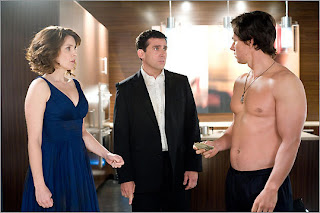
The Boyfriend and I were actually hoping to see a different film, but it was sold out, so we wound up going to see Date Night instead. If this were the 1930s, I'd use the term "screwball comedy" to characterize Date Night, and I always enjoyed those earlier films. Steve Carell and Tina Fey play a couple in the suburbs whose lives have been boring and routine. They still manage to have a "date night" on occasion, but even that is rather monotonous. After hearing that some friends are ending their marriage, Carell and Fey's Phil and Claire Foster decide to go to New York City and have an elegant, romantic evening at a fashionable restaurant. When they discover that you need a reservation far in advance, they assume the identity of another couple whose name is called. A couple of thugs with guns, thinking they are the couple with the reservation, take the Fosters into an alley behind the restaurant and attempt to kill them. What follows is a hilarious pursuit through the city, an homage to those earlier screwball comedies. Mark Wahlberg has a supporting role as one of Claire's former clients, one to whom she was obviously attracted, and he makes the most of his brief time on the screen. Carell's reaction to the flirting going on between his wife and Wahlberg's character is priceless. There's no deep meaning to this film and you won't learn any true life lessons from watching it--you already know that you should appreciate your spouse and spend more time with her or him, and you already know that sometimes a boring life with someone you love is all you truly need--but you'll certainly laugh at some of the situations in which Carell and Fey find themselves and the ways they try to get out of those situations. You don't need gimmicks like 3-D or IMAX in order to make a film like this one entertaining.

Dream Boy is a small independent movie about two next door neighbor boys who fall in love with each other and begin a furtive sexual relationship. The film is set in the South, apparently during the 1970s or early 1980s, based upon the clothing styles, and that naturally means that the boys, who are teens still in high school, have to keep their relationship a secret from their families and friends. Of course, each of the boys is saddled with trouble in their personal lives, and even though neither of the scenarios is all that unique in terms of independent gay film these days, I won't reveal the alleged surprises that occur. I will, however, readily admit to being appalled if not shocked at what happens when the boys join three of their so-called friends for a weekend getaway in the woods. (Why would people who basically live in the woods already feel a need to get away to the woods for an entire weekend? That mentality has always confused me, being from the country myself.) Both of the lead actors, Stephan Bender and Maximilian Roeg, are quite good, and it was a pleasure to see Diana Scarwid and Rickie Lee Jones playing their mothers. And I always enjoy seeing cinematography of the South when it's handled this well; it creates quite an appropriate mood and atmosphere.

How to Train Your Dragon was one of the highlights of the year for me. I'll be honest and admit that I didn't have high expectations based upon the few trailers I had seen, but when The Boyfriend insisted, I went along, paying for the 3-D and IMAX enhanced version as well. And, boy, am I glad that I did. This is a relatively simple tale of a young Viking named Hiccup (voiced by Jay Baruchel) who is an outsider in his village. He doesn't seem to be as athletic as his fellow teens or as interested in dragon slaying as they are. He does, though, want to fit in, so he begins going to classes in how to hunt and kill dragons, and we in the audience learn about the different varieties of dragons--a charming sequence in the film. Hiccup gets involved in defending the village from a dragon attack and injures a rare dragon of the Night Fury variety. He befriends it rather than kills it, and he and the girl he loves (you knew there would be a love interest) enjoy spending time helping the beast Hiccup has nicknamed Toothless regain his ability to fly. I suppose I don't need to tell you that Hiccup becomes the true hero of the story or that Toothless is integral to his success; you have seen enough movies about outsiders to know how this all ends. Yet knowing that some of the standard cliches are going to be included doesn't detract from the joy of watching some thrilling flying sequences or enjoying some broadly comic scenes involving Hiccup and his fellow schoolmates. This was one of the few movies in 3-D that I saw this year that was truly deserving of putting on those funny glasses.
 I have never been a fan of the slasher genre of films. I've seen a few over the years, but I could never quite understand the appeal of watching some crazed killer devise new ways to off people. It always seemed like a sick joke to me that there's a large audience out there for these kinds of movies. The Boyfriend, however, is a huge fan (although he does have an odd tendency to hide his eyes whenever a particularly gruesome murder takes place while I'm always able to watch and be disgusted by what I see--go figure). So you can imagine my reluctance to go see A Nightmare on Elm Street, the "rebooting" of the series that stretches back to the 1980s. I think I had seen one of them, but The Boyfriend has seen them all and wanted to compare this one to those he already knew and apparently enjoyed. Well, even he didn't like this one. It's an attempt to give us a history of how Freddy Krueger (played now by Jackie Earle Haley) became the killer that he is. There's a backstory involving a class of students who all share a secret that I won't reveal even though it isn't all that surprising anyway. They begin dying off one by one, but to be honest, I found it difficult to care about any of them because they are so underdeveloped as individual characters and the actors portraying them are all relatively bland. Even the hunky Kellan Lutz, probably better known from those Eclipse movies, is wasted here, as is the great Connie Britton as the mother of one of the girls who is consistently tormented throughout the film. The Boyfriend, being more knowledgeable about the series, tried to explain some of the links to the original that the filmmakers tried to incorporate, but I think a film should be able to stand on its own, particularly when you're trying to delve into the origin of one of the most famous slashers in the past few decades. At the end of this film, all I felt was as exhausted.

Tim Burton's Alice in Wonderland is, in my opinion, a real mess. It has a convoluted story with far too much bizarre non sequitur type stuff going on. I know it's somewhat spectacular (or garish, depending upon your perspective) to look at, but why couldn't he and his colleagues simply have used the plot from the Lewis Carroll novel? Why did it have to be some meta-narrative about Alice returning to Wonderland and re-encountering people she had met there before in her childhood dreams? And why does it have to be called "Underland" when that's not in the title of the movie? And why were so many talented people wasted in such strange parts? I like Helena Bonham Carter and Anne Hathaway and even Johnny Depp (when he isn't in these latter day Burton movies, that is), but they are just given strange things to do here. None of them get to play fully developed characters because Burton and his collaborators have strayed too far from the source material in their attempts to be clever and artsy. Carroll knew how to make the Mad Hatter (Depp's thankless role here) interesting. All Burton can do is make him dance a very strange dance and mumble jibberish. And having seen Mia Wasikowska (who plays Alice) in other roles such as the daughter in The Kids Are All Right, I know she has a great deal of promise as an actress, but she's so passive and bland as Alice that I couldn't imagine why anyone would build an entire movie around her. Yes, The Boyfriend and I saw this in IMAX and 3-D, but I can't say that either of those "experiences" truly enhanced my enjoyment of this movie.

Clash of the Titans was nowhere near as fun or as campy as the "original" from 1981, but nowadays films have to be special effects extravaganzas in order to be considered event movies like this one. In making the focus primarily upon special effects rather than, say, characterization, the filmmakers tend to lose the interest of a lot of viewers like me. I found this to be little more than what's been dubbed a "popcorn" movie: a few hours away from it and you forget almost all of it. There's little nourishment to be had. Sam Worthington, fresh from his success in Avatar, is the lead here as Perseus, a mortal son of Zeus whom the gods have given the unenviable task of saving the world from Hades and his evil minions. I expect Worthington to continue being promoted as the latest It Boy, but he doesn't strike me as the type who can handle a movie that isn't primarily about the special effects. Hades (played by Ralph Fiennes, who seems to be interested only in supporting parts these days and the odder, the better) plans to conquer the heavens eventually as well, so Zeus (Liam Neeson) has a stake in Perseus' eventual success. You don't really watch a movie like this for the plot, however, or for learning about the mythology upon which it's allegedly based. No, a film like this is primarily an opportunity to see how well the special effects team can create super-sized scorpions (try saying that one three times fast) and the kraken/cracken/whatever, and all of that is well done (although I still miss the days when Ray Harryhausen did special effects for films like this and the viewing of them was more fun). Like Alice in Wonderland, Clash of the Titans had also been converted to 3-D after its making, but we were able to see it in its original 2-D format. Again, I don't think there's anything about 3-D that would have enhanced the experience for me.

The Boyfriend and I were actually hoping to see a different film, but it was sold out, so we wound up going to see Date Night instead. If this were the 1930s, I'd use the term "screwball comedy" to characterize Date Night, and I always enjoyed those earlier films. Steve Carell and Tina Fey play a couple in the suburbs whose lives have been boring and routine. They still manage to have a "date night" on occasion, but even that is rather monotonous. After hearing that some friends are ending their marriage, Carell and Fey's Phil and Claire Foster decide to go to New York City and have an elegant, romantic evening at a fashionable restaurant. When they discover that you need a reservation far in advance, they assume the identity of another couple whose name is called. A couple of thugs with guns, thinking they are the couple with the reservation, take the Fosters into an alley behind the restaurant and attempt to kill them. What follows is a hilarious pursuit through the city, an homage to those earlier screwball comedies. Mark Wahlberg has a supporting role as one of Claire's former clients, one to whom she was obviously attracted, and he makes the most of his brief time on the screen. Carell's reaction to the flirting going on between his wife and Wahlberg's character is priceless. There's no deep meaning to this film and you won't learn any true life lessons from watching it--you already know that you should appreciate your spouse and spend more time with her or him, and you already know that sometimes a boring life with someone you love is all you truly need--but you'll certainly laugh at some of the situations in which Carell and Fey find themselves and the ways they try to get out of those situations. You don't need gimmicks like 3-D or IMAX in order to make a film like this one entertaining.

Dream Boy is a small independent movie about two next door neighbor boys who fall in love with each other and begin a furtive sexual relationship. The film is set in the South, apparently during the 1970s or early 1980s, based upon the clothing styles, and that naturally means that the boys, who are teens still in high school, have to keep their relationship a secret from their families and friends. Of course, each of the boys is saddled with trouble in their personal lives, and even though neither of the scenarios is all that unique in terms of independent gay film these days, I won't reveal the alleged surprises that occur. I will, however, readily admit to being appalled if not shocked at what happens when the boys join three of their so-called friends for a weekend getaway in the woods. (Why would people who basically live in the woods already feel a need to get away to the woods for an entire weekend? That mentality has always confused me, being from the country myself.) Both of the lead actors, Stephan Bender and Maximilian Roeg, are quite good, and it was a pleasure to see Diana Scarwid and Rickie Lee Jones playing their mothers. And I always enjoy seeing cinematography of the South when it's handled this well; it creates quite an appropriate mood and atmosphere.

How to Train Your Dragon was one of the highlights of the year for me. I'll be honest and admit that I didn't have high expectations based upon the few trailers I had seen, but when The Boyfriend insisted, I went along, paying for the 3-D and IMAX enhanced version as well. And, boy, am I glad that I did. This is a relatively simple tale of a young Viking named Hiccup (voiced by Jay Baruchel) who is an outsider in his village. He doesn't seem to be as athletic as his fellow teens or as interested in dragon slaying as they are. He does, though, want to fit in, so he begins going to classes in how to hunt and kill dragons, and we in the audience learn about the different varieties of dragons--a charming sequence in the film. Hiccup gets involved in defending the village from a dragon attack and injures a rare dragon of the Night Fury variety. He befriends it rather than kills it, and he and the girl he loves (you knew there would be a love interest) enjoy spending time helping the beast Hiccup has nicknamed Toothless regain his ability to fly. I suppose I don't need to tell you that Hiccup becomes the true hero of the story or that Toothless is integral to his success; you have seen enough movies about outsiders to know how this all ends. Yet knowing that some of the standard cliches are going to be included doesn't detract from the joy of watching some thrilling flying sequences or enjoying some broadly comic scenes involving Hiccup and his fellow schoolmates. This was one of the few movies in 3-D that I saw this year that was truly deserving of putting on those funny glasses.

Wednesday, December 1, 2010
Planning Ahead
We had been working on doing some prewriting activities for the final essay of the semester in my developmental writing classes. Not horribly complicated stuff. Just getting some ideas down on paper for use in the rough draft. We'd been at it for about an hour, and I suggested that most of the information needed for a response to the assignment was now on the sheets of paper in front of them. I then asked them to take what we had previously discussed about organization and write an outline for the rough draft. I thought I would get some solid attempts at putting together a framework for an essay, but I have to admit that my favorite came from one of the football players. His outline, preserved in its original form:
- intro
- body
- body
- body
- conlusion [sic]
Spiritual Awakening
The assignment was a relatively simple one. I asked students to watch a movie or television show, select a specific group of people depicted on that show or in the movie, and then explain what a viewer's impression of that group would be based upon how it was depicted. I did suggest that it might be more interesting to choose a group of which the student was not a member.
The students (all of them in my developmental writing classes) made some intriguing choices: serial killers (Dexter), Alaskans (The Proposal), gypsies or "pikeys" (Snatch), pirates (One Piece), married men (Old School), bosses (The Office), snipers (Enemy at the Gates), even Jedis (Star Wars Episode II: The Attack of the Clones). A few faltered in the explanation of how the group was depicted, but it was only a rough draft, so I expect the final drafts will likely be stronger and have more examples and other details.
One, however, stood out not only for the group chosen for discussion but also for a couple of astonishing statements. The students is a tall, athletic Latino. I have reason to suspect that he might be religious given the brochures for the Latter Day Saints that I've seen in his notebook. I would never have suspected that he would choose Pineapple Express as the movie and potheads as the group. The overall essay was strong for a rough draft, but when I read the following statements in the introduction, I have to admit that I was pretty shocked: "People are very judgmental nowadays and they will try to determine the type of person you are by any little thing that they see. For instance people that smoke Marijuana are looked at upon in a very bad way just because they smoke a natural herb that God created for us." In the conclusion, he returned to the same idea: "Potheads are not bad people, they smoke a natural herb that was placed here by God. Humans don't add any chemicals or change the material to make what they want. It is a natural plant and you can pick it and smoke it instantly, other drugs need to be played around with to get the final result, but that's why marijuana is not bad." Yes, I preserved his grammatical errors in the quote, not to mention his apparent lack of knowledge of how people...um..."use" marijuana.
I know I probably shouldn't be shocked that there's a Christian rationalization for pot smoking. People can probably justify almost anything under the umbrella of religious faith. It just seemed so out of character for this young man. He states in his essay that he doesn't smoke pot (although he has friends who do) and I suspect that to be the case, but I would have never considered him to be a supporter of marijuana use. He even defended potheads as being more goal-oriented that people typically give them credit for being.
I feel like I learn something astonishing with almost every set of papers I read these days.
The students (all of them in my developmental writing classes) made some intriguing choices: serial killers (Dexter), Alaskans (The Proposal), gypsies or "pikeys" (Snatch), pirates (One Piece), married men (Old School), bosses (The Office), snipers (Enemy at the Gates), even Jedis (Star Wars Episode II: The Attack of the Clones). A few faltered in the explanation of how the group was depicted, but it was only a rough draft, so I expect the final drafts will likely be stronger and have more examples and other details.
One, however, stood out not only for the group chosen for discussion but also for a couple of astonishing statements. The students is a tall, athletic Latino. I have reason to suspect that he might be religious given the brochures for the Latter Day Saints that I've seen in his notebook. I would never have suspected that he would choose Pineapple Express as the movie and potheads as the group. The overall essay was strong for a rough draft, but when I read the following statements in the introduction, I have to admit that I was pretty shocked: "People are very judgmental nowadays and they will try to determine the type of person you are by any little thing that they see. For instance people that smoke Marijuana are looked at upon in a very bad way just because they smoke a natural herb that God created for us." In the conclusion, he returned to the same idea: "Potheads are not bad people, they smoke a natural herb that was placed here by God. Humans don't add any chemicals or change the material to make what they want. It is a natural plant and you can pick it and smoke it instantly, other drugs need to be played around with to get the final result, but that's why marijuana is not bad." Yes, I preserved his grammatical errors in the quote, not to mention his apparent lack of knowledge of how people...um..."use" marijuana.
I know I probably shouldn't be shocked that there's a Christian rationalization for pot smoking. People can probably justify almost anything under the umbrella of religious faith. It just seemed so out of character for this young man. He states in his essay that he doesn't smoke pot (although he has friends who do) and I suspect that to be the case, but I would have never considered him to be a supporter of marijuana use. He even defended potheads as being more goal-oriented that people typically give them credit for being.
I feel like I learn something astonishing with almost every set of papers I read these days.
Subscribe to:
Posts (Atom)